
The evidentiary core
Four AMEE Guides, a searchable publication record, edited volumes, and the validated tools built along the way.
Edited volumes
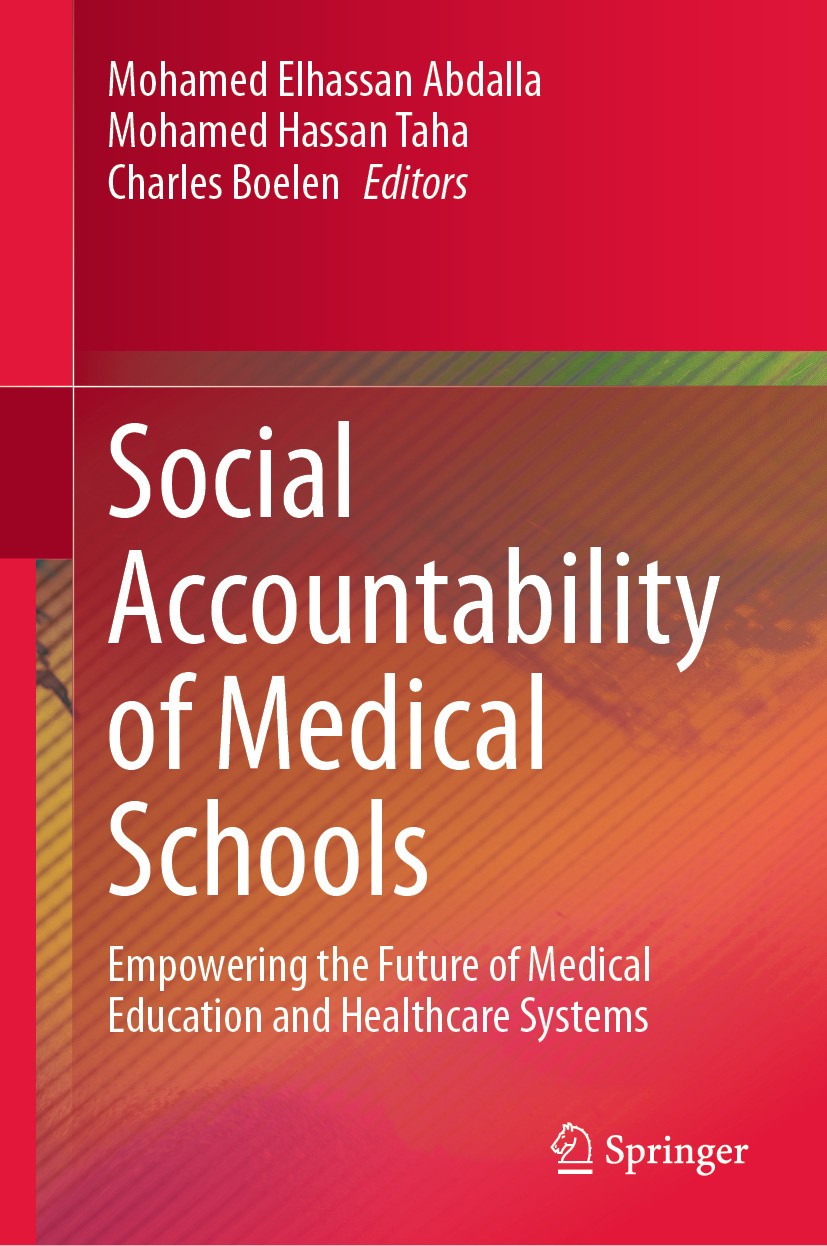
Social Accountability of Medical Schools: Empowering the Future of Medical Education and Healthcare Systems
The Evolving Role of the Medical Profession and Medical Graduates (pp. 17–29); Governance and Leadership for Socially Accountability (pp. 53–71)
Co-edited by Mohamed Elhassan Abdalla, Mohamed Hassan Taha and Charles Boelen, this book explores how medical schools can align education, research and service with community health priorities. International perspectives and case studies address leadership, governance, community engagement, curriculum reform and assessment. Dr Taha also co-authored two chapters examining the evolving role of the medical profession and the governance and leadership needed to advance social accountability.
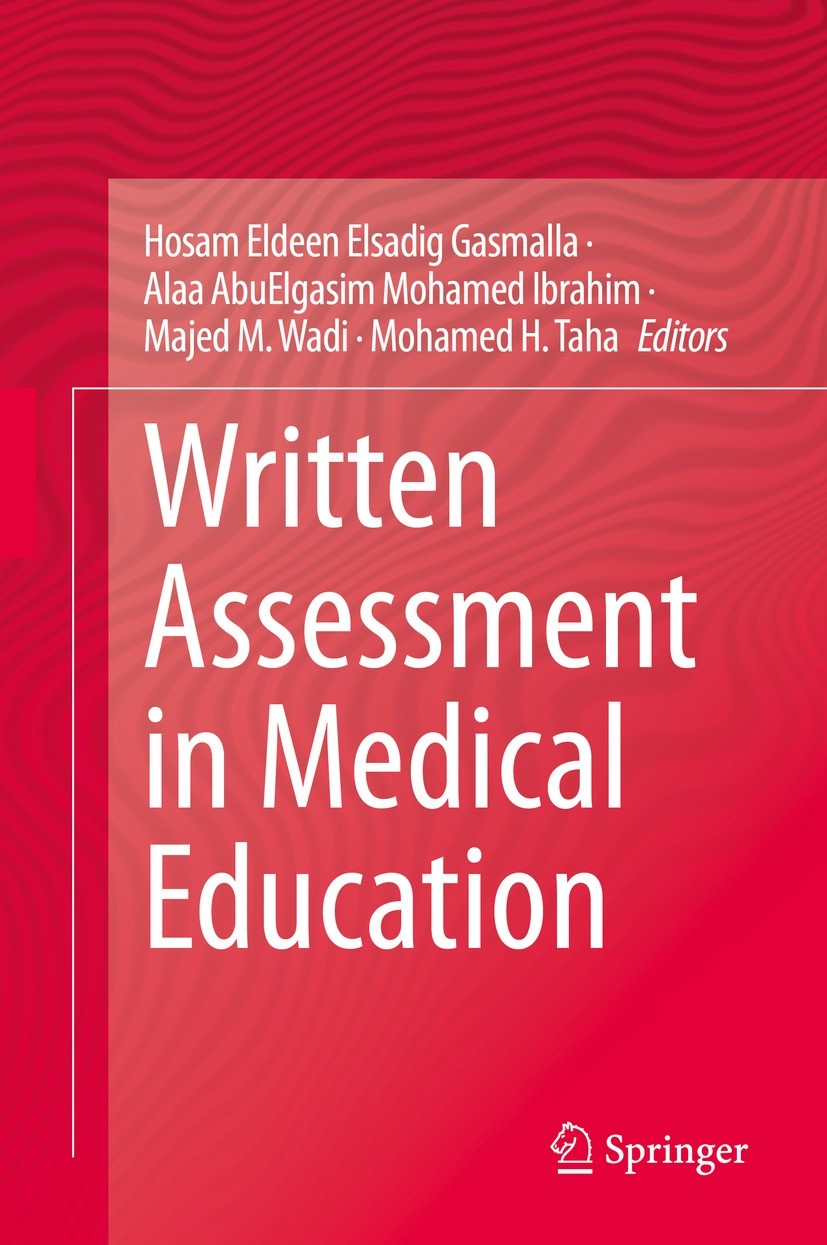
Written Assessment in Medical Education
Constructed Response Items (pp. 39–48)
A practical reference co-edited by Dr Mohamed H. Taha, supporting medical educators in designing and evaluating written assessments. The book covers assessment blueprints, question formats, psychometric analysis, standard setting and progress testing. Dr Taha authored the chapter “Constructed Response Items,” which explains essay and short-answer formats, their applications, strengths and limitations, and how to develop questions that assess higher-order thinking.
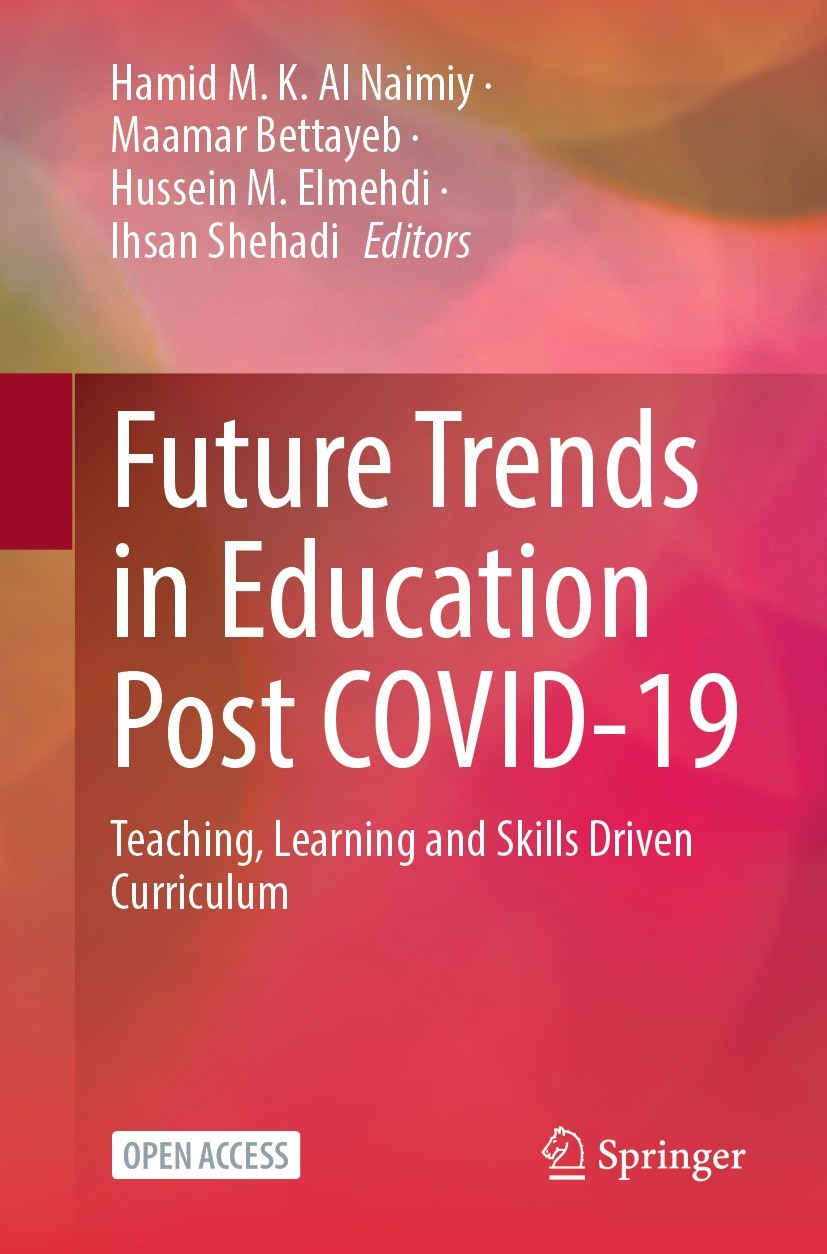
Future Trends in Education Post COVID-19: Teaching, Learning and Skills Driven Curriculum
Effectiveness of HyFlex Simulation-Based Clinical Learning in Comparison to Traditional Learning in Undergraduate Clinical Education (pp. 191–203)
Dr Mohamed H. Taha contributed to this open-access conference volume through a co-authored chapter on HyFlex simulation in clinical education. Drawing on a survey of 124 radiography students and graduates at the University of Sharjah, the chapter examines reported satisfaction and learning experiences. It discusses the potential of flexible simulation while recognising participants’ preference for face-to-face learning when acquiring practical skills.
Signature guides
Leadership as a Catalyst for Advancing Social Accountability in Health Professions Education
Shows how leadership can turn social accountability commitments into institutional action. Provides practical guidance for aligning governance, curricula, community partnerships, and research with population health priorities. Read guide Social accountability in health professions education Guide No. 182Building Resilient Health Professions Education in Fragile Contexts
Offers practical guidance for educators and institutional leaders seeking to sustain training during crises. It connects immediate educational responses with longer-term preparedness, learner support and institutional recovery in fragile settings. Read guide Resilience, Fragile Contexts and Adaptive Educational Strategies Guide No. 175Instilling Social Accountability into the Health Professions Education Curriculum with International Case Studies
Helps educators translate community health priorities into curriculum decisions. Combines a practical framework with international examples to support socially accountable teaching and institutional commitment. Read guide Social accountability in health professions education Guide No. 162Integrating the Social Determinants of Health into Curriculum
Connects curriculum development with health equity by helping educators prepare learners to understand patients’ social circumstances. Supports medical education that responds to the needs of underserved communities. Read guide Social accountability in health professions educationPublication record
| Title | Authors | Journal | Year | |
|---|---|---|---|---|
| Curriculum Delivery in Medical Education During an Emergency: A Guide Based on the Responses to the COVID-19 Pandemic This practical guide draws on the authors’ experience of moving medical education online during the COVID-19 emergency. It outlines a coordinated approach covering needs assessment, implementation planning, faculty development, student support, engagement and assessment. The article emphasises anticipating barriers and continuously evaluating curriculum delivery to help medical schools maintain teaching and learning during major disruptions. |
Taha, M. H., Abdalla, M. E., Wadi, M., & Khalafalla, H. | MedEdPublish, 9, Article 69 | 2020 | DOI |
| Improvement of the Medical Education Situation in Sudan: Collegectomy is Not the Only Management Option This editorial examines options for improving medical education in Sudan amid concerns about the quality of an expanding number of medical schools. It advocates evaluating each institution individually, balancing educational standards with community health needs. Drawing on international experience, the authors discuss financial and technical support, curriculum reform, social accountability, and collaboration between colleges to share expertise and learning resources. Closure remains an option when other approaches are not feasible, but should not be treated as the only solution. |
Abdalla, M. E., & Taha, M. H. | Sudan Journal of Medical Sciences, 15(1), 85–90 | 2020 | DOI |
| Knowledge, Anxiety, Fear, and Psychological Distress About COVID-19 Among University Students in the United Arab Emirates This cross-sectional study surveyed 433 University of Sharjah students during May 2020 to examine COVID-19 knowledge and psychological wellbeing. Although 81.5% demonstrated adequate knowledge, 51% met the study’s screening threshold for psychological distress. Distress was associated with factors including anxiety, fear, a history of mental illness and spending more than four hours reading about COVID-19. The authors recommended accessible psychological support and coping guidance. The findings describe associations within one university and do not establish causation. |
Coumaravelou Saravanan; Ibrahim Mahmoud; Wiam Elshami; Mohamed H. Taha | Frontiers in Psychiatry, 11, Article 582189 | 2020 | DOI |
| The assessment clock: A model to prioritize the principles of the utility of assessment formula in emergency situations, such as the COVID-19 pandemic This article proposes the “assessment clock,” a conceptual model for prioritizing validity, reliability, educational impact, acceptability and cost when choosing assessment methods. It considers both the stakes of an assessment and whether it occurs under normal or emergency conditions. Developed in response to COVID-19, the model encourages educators to address feasibility and acceptance during sudden transitions while maintaining attention to validity and reliability in high-stakes examinations. It offers practical guidance rather than evidence from an empirical evaluation of the model. |
Majed Wadi; Mohamed Elhassan Abdalla; Husameldin Khalafalla; Mohamed H. Taha | MedEdPublish, 9, 86 | 2020 | DOI |
| Why Social Accountability of Medical Schools in Sudan Can Lead to Better Primary Healthcare and Excellence in Medical Education? This critical review examines how social accountability could strengthen medical education and primary healthcare in Sudan, particularly in rural communities. Drawing on literature and regional examples, it advocates aligning education, research, and services with community health needs. It calls for a national alliance between medical schools and highlights primary care physicians’ leadership in implementation. |
Ahmed, M. H., Abdalla, M. E., & Taha, M. H. | Journal of Family Medicine and Primary Care | 2020 | DOI |
| Assessing Patient Satisfaction with Sudanese Doctors This letter reports a cross-sectional survey of 389 patients receiving care from internal medicine doctors at a teaching hospital in Wad Medani, Sudan. Overall satisfaction was 66.1%. Patients valued respectful interactions, privacy during examinations and explanations of treatment results, while identifying concerns about listening, medication instructions, consultation time and explanations of investigations. The findings highlight communication priorities for residency training. They reflect patients’ reported experiences, with possible bias where relatives answered on patients’ behalf. |
Mohamed H. Taha | Journal of Advances in Medical Education & Professionalism, 7(2), 106–107 | 2019 | DOI |
| Does Curriculum Analysis in Clinical Residency Training Need to Be Different? This qualitative study analyses the internal medicine residency curriculum of the Sudan Medical Specialisation Board using Harden’s Ten Questions framework. Document analysis identified clear objectives and alignment with community needs, alongside gaps in clinical teaching, assessment and the learning environment. The authors propose adapting the framework for postgraduate training by incorporating entrustable professional activities, developmental milestones and faculty preparation. The study provides a structured approach to reviewing and improving residency curricula. |
Taha, M. H., Abdalla, M. E. H., & Ahmed, Y. | Journal of Medical Education and Curricular Development, 6, Article 2382120519888639 | 2019 | DOI |
| Evaluation of the learning environment and the perceived weakness of the curriculum: student perspective This mixed-methods study explored medical students’ perceptions of the learning environment at the University of Gezira, Sudan. An updated Arabic DREEM questionnaire was completed by 638 students, while 546 provided open-ended feedback. The overall score of 122 out of 200 indicated a more positive than negative environment. Students nevertheless identified concerns involving teaching approaches, support for stressed students, accommodation and faculty–student communication. The findings provide student-informed priorities for improving curriculum delivery and learning conditions. |
Yasar Ahmed; Mohamed H. Taha; Salma Alneel; Abdelrahim M. Gaffar | International Journal of Research in Medical Sciences, 7(1), 165–173 | 2019 | DOI |
| Exploring Factors Affecting the Quality of Postgraduate Medical Education in Sudan: Residents Perspective This cross-sectional study surveyed 181 internal medicine residents in Sudan about the quality of their postgraduate training. Overall satisfaction was described as average. Residents identified strengths in training duration, communication skills and lifelong learning, alongside concerns about curriculum delivery, learning environments, supervision, assessment and research opportunities. Their responses highlighted priorities for clearer curriculum communication, stronger feedback and improved training support. The findings represent residents’ perceptions and do not establish causal effects on clinical performance. |
Mohamed H. Taha; Yasar Ahmed; Mohamed E. Abdalla; Abdelrahim M. Gaffar | International Journal of Medical Science and Education, 6(2), 7–15 | 2019 | DOI |
| Internal Medicine Residents’ perceptions of learning environments in postgraduate training in Sudan This cross-sectional study assessed how 181 internal medicine residents perceived their learning environments at five teaching hospitals in Sudan. Using the Postgraduate Hospital Educational Environment Measure (PHEEM), it found a mean score of 72.4 out of 160, indicating substantial room for improvement. Low-rated areas included orientation, training manuals, clarity of expectations, protected educational time and supervision. The findings identify priorities for strengthening residency learning environments, based on residents’ perceptions rather than direct measurement of clinical performance. |
Mohamed H. Taha; Yasar Ahmed; Yasser A. M. El Hassan; Nahid Abdelgadir Ali; Majed Wadi | Future of Medical Education Journal, 9(4), 3–9 | 2019 | DOI |
Instruments and tools
Social Accountability Inventory for PBL
A validated instrument for evaluating how well social accountability principles are reflected in PBL case scenarios.
Curriculum committees, PBL case writers, programme evaluators.
Read moreThe Assessment Clock
A framework guiding assessment decision-making during educational emergencies — building on Van der Vleuten's assessment utility model, it shows how the relative weight of validity, reliability, educational impact, acceptability and feasibility shifts by context, so educators can make transparent, defensible assessment decisions when conventional approaches become impracticable.
Assessment committees and programme leaders planning for emergency or fragile-context delivery.