
The evidentiary core
Four AMEE Guides, a searchable publication record, edited volumes, and the validated tools built along the way.
Edited volumes
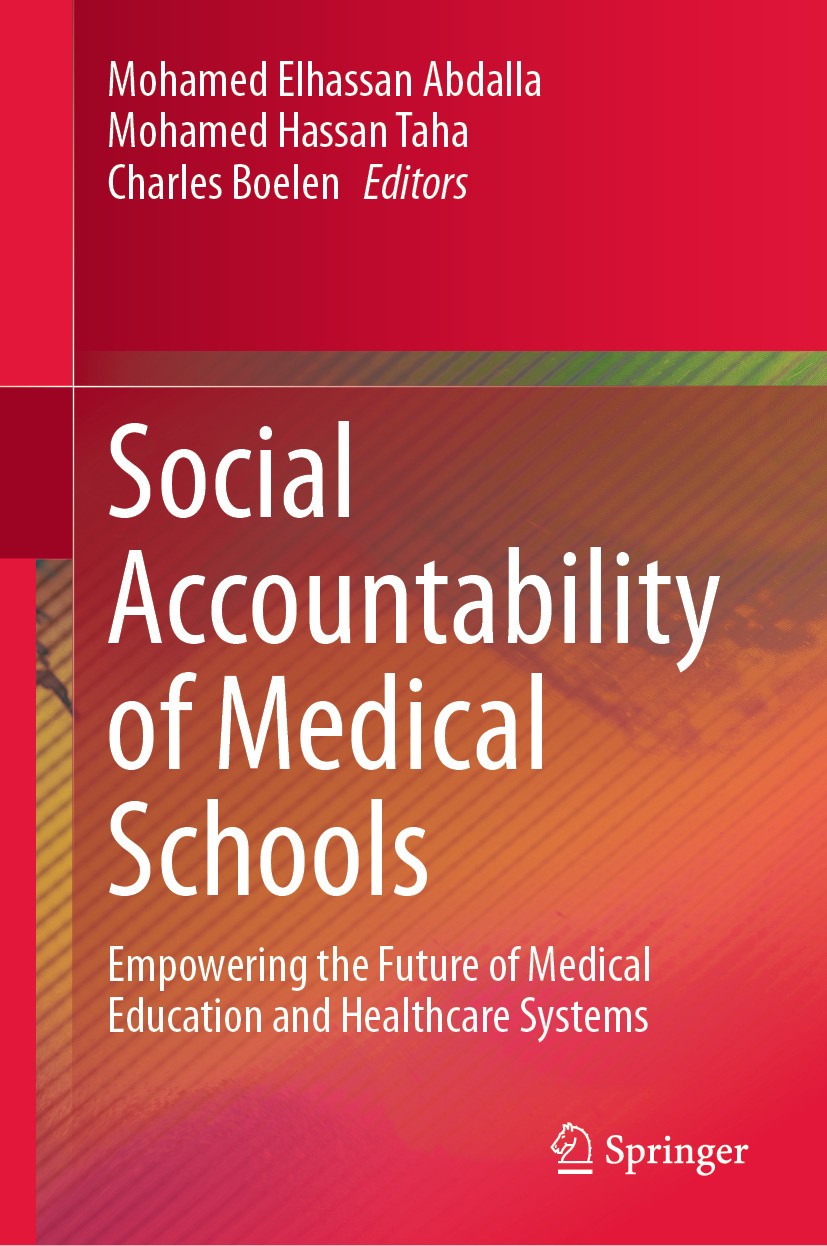
Social Accountability of Medical Schools: Empowering the Future of Medical Education and Healthcare Systems
The Evolving Role of the Medical Profession and Medical Graduates (pp. 17–29); Governance and Leadership for Socially Accountability (pp. 53–71)
Co-edited by Mohamed Elhassan Abdalla, Mohamed Hassan Taha and Charles Boelen, this book explores how medical schools can align education, research and service with community health priorities. International perspectives and case studies address leadership, governance, community engagement, curriculum reform and assessment. Dr Taha also co-authored two chapters examining the evolving role of the medical profession and the governance and leadership needed to advance social accountability.
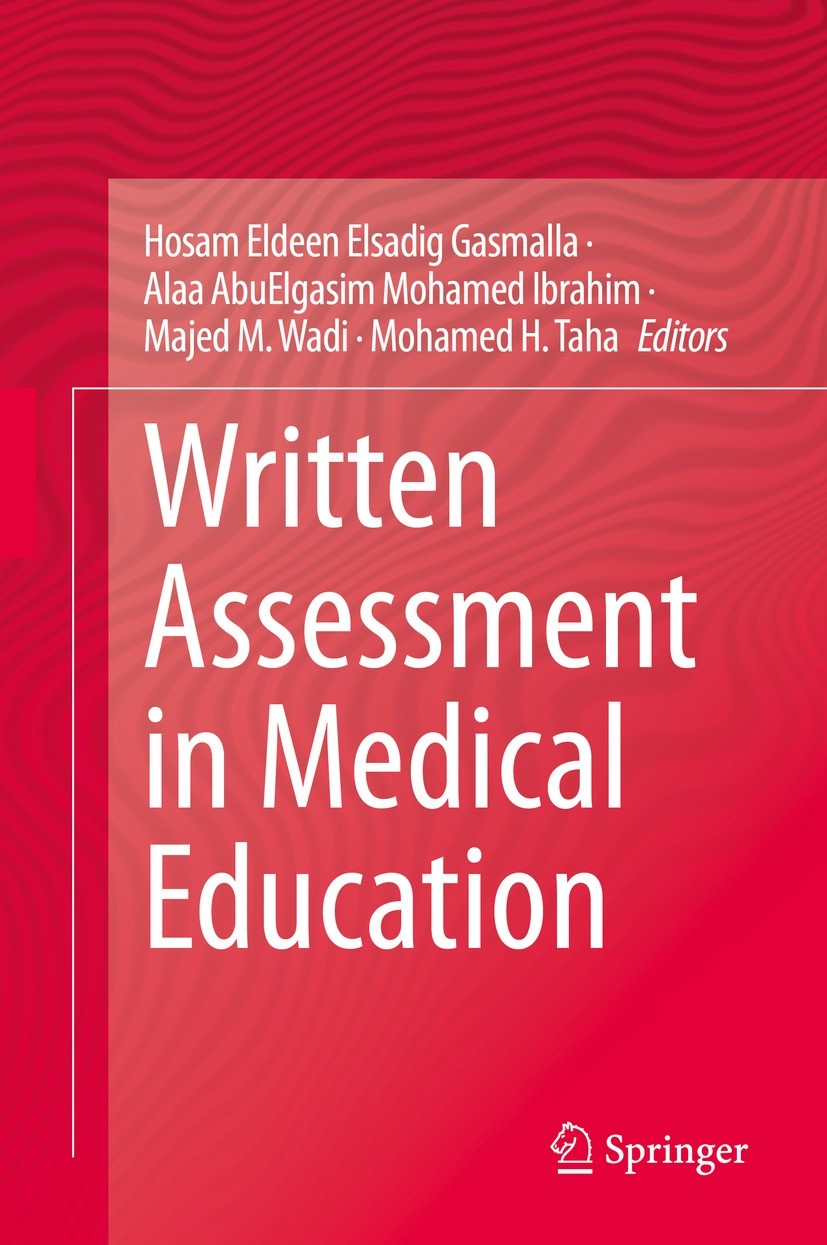
Written Assessment in Medical Education
Constructed Response Items (pp. 39–48)
A practical reference co-edited by Dr Mohamed H. Taha, supporting medical educators in designing and evaluating written assessments. The book covers assessment blueprints, question formats, psychometric analysis, standard setting and progress testing. Dr Taha authored the chapter “Constructed Response Items,” which explains essay and short-answer formats, their applications, strengths and limitations, and how to develop questions that assess higher-order thinking.
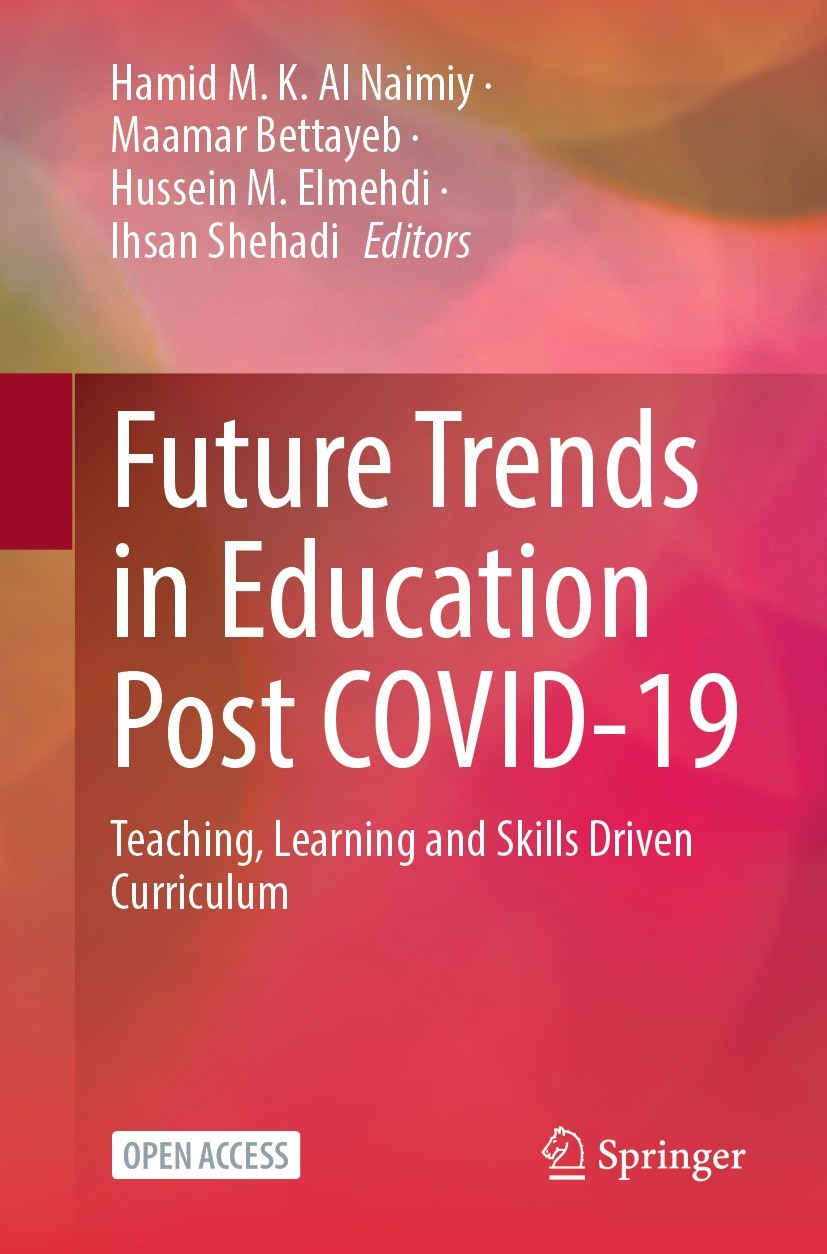
Future Trends in Education Post COVID-19: Teaching, Learning and Skills Driven Curriculum
Effectiveness of HyFlex Simulation-Based Clinical Learning in Comparison to Traditional Learning in Undergraduate Clinical Education (pp. 191–203)
Dr Mohamed H. Taha contributed to this open-access conference volume through a co-authored chapter on HyFlex simulation in clinical education. Drawing on a survey of 124 radiography students and graduates at the University of Sharjah, the chapter examines reported satisfaction and learning experiences. It discusses the potential of flexible simulation while recognising participants’ preference for face-to-face learning when acquiring practical skills.
Signature guides
Leadership as a Catalyst for Advancing Social Accountability in Health Professions Education
Shows how leadership can turn social accountability commitments into institutional action. Provides practical guidance for aligning governance, curricula, community partnerships, and research with population health priorities. Read guide Social accountability in health professions education Guide No. 182Building Resilient Health Professions Education in Fragile Contexts
Offers practical guidance for educators and institutional leaders seeking to sustain training during crises. It connects immediate educational responses with longer-term preparedness, learner support and institutional recovery in fragile settings. Read guide Resilience, Fragile Contexts and Adaptive Educational Strategies Guide No. 175Instilling Social Accountability into the Health Professions Education Curriculum with International Case Studies
Helps educators translate community health priorities into curriculum decisions. Combines a practical framework with international examples to support socially accountable teaching and institutional commitment. Read guide Social accountability in health professions education Guide No. 162Integrating the Social Determinants of Health into Curriculum
Connects curriculum development with health equity by helping educators prepare learners to understand patients’ social circumstances. Supports medical education that responds to the needs of underserved communities. Read guide Social accountability in health professions educationPublication record
| Title | Authors | Journal | Year | |
|---|---|---|---|---|
| Psychometric properties of the Persian version of the Engaged teachers Scale (ETS) This study translated, culturally adapted and evaluated the Persian version of the 16-item Engaged Teachers Scale among 123 educators at an Iranian medical university. It examined cognitive and emotional engagement, alongside social engagement with students and colleagues. The analysis supported the four-factor structure and reported acceptable internal consistency, with a Cronbach’s alpha of 0.79. The findings provide initial support for using the scale to assess teacher engagement, although the limited sample warrants caution when applying it to other settings. |
Maryam Akbarilakeh; Soleiman Ahmady; Faezeh Shademani Farhang; Azizollah Arbabisarjou; Mohamed Hassan Taha | BMC Medical Education, 24, Article 574 | 2024 | DOI |
| The pattern of reporting and presenting validity evidence of extended matching questions (EMQs) in health professions education: a systematic reviewThe pattern of reporting and presenting validity evidence of extended matching questions (EMQs) in health professions education: a systematic review This systematic review examined how 19 studies reported and presented validity evidence for extended matching questions in health professions education. Using a framework covering five sources of validity evidence, it identified incomplete reporting and frequent reliance on reliability coefficients and relationships with other measures. The findings highlight the need for clearer reporting guidance and more comprehensive evidence to support assessment score interpretations. The review identifies weaknesses in the published evidence rather than demonstrating that extended matching questions are inherently invalid. |
Mohamed H. Taha; Hosam Eldeen Elsadig Gasmalla Mohammed; Mohamed Elhassan Abdalla; Muhamad Saiful Bahri Yusoff; Mohd Kamal Mohd Napiah; Majed M. Wadi | Medical Education Online, 29(1), 2412392 | 2024 | DOI |
| Assessment of the Compliance of Problem-Based Learning Case Scenarios with the Social Accountability Values in Undergraduate Medical Education Curriculum This study assesses 63 problem-based learning case scenarios using a validated social accountability inventory. Most cases addressed relevant community health concerns, but gaps remained in representation of underserved groups, treatment costs, and person-centred care. The findings identify practical priorities for revising teaching cases to better reflect societal needs. |
Ghaly, M., Taha, M. H., Abdalla, M. E., & Hosny, S. | Health Professions Education | 2023 | DOI |
| The Framework of Systematic Assessment for Resilience (SAR): Development and Validation This study develops and validates the Systematic Assessment for Resilience (SAR) framework for health professions education. Drawing on literature reviews, student focus groups and expert evaluation, it presents 19 practical guidelines organised across five assessment phases. The framework aims to strengthen student resilience through assessment planning and practice, with expert evaluation providing evidence of content and face validity. |
Wadi, M. M., Yusoff, M. S. B., Taha, M. H., Shorbagi, S., Nik Lah, N. A. Z., & Abdul Rahim, A. F. | BMC Medical Education, 23, Article 213 | 2023 | DOI |
| The Implementation of Social Accountability in Medical Schools in Eastern Mediterranean Region: A Scoping Review This scoping review examines 26 publications from seven countries on social accountability in Eastern Mediterranean medical schools. It explores accreditation, educational programmes, admissions, faculty and student perspectives, and evaluation. The findings highlight gaps between social accountability principles and everyday institutional practice, calling for stronger educational and health-system leadership to support implementation. |
Taha, M. H., Abdalla, M. E., Saleh Wadi, M. M., Khalafalla, H. E., & Akbarilakeh, M. | Journal of Taibah University Medical Sciences | 2023 | DOI |
| Evaluation of an Internal Medicine Residency Curriculum from Trainees’ Perspective: A Qualitative Study from a Developing Country This qualitative study explored internal medicine residents’ views of their training curriculum in Sudan through six focus groups involving 48 residents at six teaching hospitals. Participants generally valued the programme’s structure and duration but identified improvements needed in curriculum delivery, research training and assessment. They recommended earlier research preparation, dedicated research time and stronger assessment and feedback practices. The study offers trainee-informed priorities for improving postgraduate medical education, based on reported experiences rather than measured changes in clinical competence. |
Mohamed H. Taha; Mohamed El Hassan Abdalla; Abdelrahim Mutwakel Gaffar; Yasar Ahmed | Current Medical Issues, 20(1), 10–15 | 2022 | DOI |
| Evaluation of the Integration of Social Accountability Values into Medical Education Using a Problem-Based Learning Curriculum This study evaluates 70 problem-based learning cases at the University of Sharjah using a validated social accountability inventory. Many cases addressed community health priorities, professionalism, and social determinants of health, while gaps concerned cost-effectiveness, underserved populations, and multidisciplinary care. The findings identify curriculum improvements to better prepare graduates for societal health needs. |
Dash, N. R., Taha, M. H., Shorbagi, S., & Abdalla, M. E. | BMC Medical Education | 2022 | DOI |
| Factors that affect student engagement in online learning in health professions education This cross-sectional study examined online learning engagement through responses from 315 students and 60 faculty members in medical and health sciences education. Exploratory factor analysis identified four areas perceived to support engagement: integrating technology with teaching, self-directed learning, collaborative learning and peer-assisted learning. The authors recommend strengthening faculty capabilities, updating course design and improving institutional support for online education. The findings reflect participants’ perceptions during the COVID-19 transition and provide guidance for designing more engaging digital learning experiences. |
Elshami, W., Taha, M. H., Abdalla, M. E., Abuzaid, M., Saravanan, C., & Al Kawas, S. | Nurse Education Today, 110, 105261 | 2022 | DOI |
| Impact of Community-Based Medical Education on Graduate Performance: A Qualitative Study Using a Critical Incident Technique This qualitative study explores how community-based medical education influenced University of Gezira graduates’ professional development and practice. Analysis of 23 critical incidents drawn from 91 responses highlighted reported benefits for leadership, patient care, professionalism, and health-system improvement. The findings support structured community-based learning that connects medical training with professional practice after graduation. |
Abdalla, M. E., Taha, M. H., Mukhtar, W. N. O., & Elsanousi, M. | Health Professions Education | 2022 | DOI |
| Medical Schools’ Efforts to Build Social Accountability Indicators and Determinants in the Eastern Mediterranean Region: A Scoping Review This scoping review examines six publications from two Eastern Mediterranean countries on social accountability indicators for medical schools. Using the Global Consensus for Social Accountability as a benchmark, it identifies gaps in how indicators address community impact, social determinants of health, primary care, admissions, and graduate outcomes. It recommends measures that better reflect community needs. |
Abdalla, M. E., Khalafalla, H. E., Wadi, M., & Taha, M. H. | Education in Medicine Journal | 2022 | DOI |
Instruments and tools
Social Accountability Inventory for PBL
A validated instrument for evaluating how well social accountability principles are reflected in PBL case scenarios.
Curriculum committees, PBL case writers, programme evaluators.
Read moreThe Assessment Clock
A framework guiding assessment decision-making during educational emergencies — building on Van der Vleuten's assessment utility model, it shows how the relative weight of validity, reliability, educational impact, acceptability and feasibility shifts by context, so educators can make transparent, defensible assessment decisions when conventional approaches become impracticable.
Assessment committees and programme leaders planning for emergency or fragile-context delivery.